
In the 1660s John Aubrey travelled around Wiltshire recording what he saw as he went - the TEXT below. Aubrey died before
he was able to research and publish his work. Some two hundred years later John Jackson undertook this task, and below - the NOTES -
are his corrections and updated information. The PLATES were sketched by Edw. Kite.
These images are from the book Wiltshire Collections by John Aubrey and John Jackson which was published by the
Wiltshire Archaeological and Natural History Society in 1862. The book is no longer covered by copyright regulations and the Society is happy
for information from the book to be copied, although ask that an acknowledgement to them is placed with the reproduction. The Society can be
contacted at: The Wiltshire Archaeological and Natural History Society, Long Street, Devizes, Wiltshire. Telephone: +44 (0) 1380 727369.
The copyright of any images of the book (but not the information contained in them) is owned by Mandy Ball so they are covered by
copyright regulations - see our copyright conditions of use. The entire book is
available on CD - Book infoCD info
Please note: The original paper size is approx. 21cm by 27.5cm (8.5in by 10.8in), the printed area approx. 15cm (6in) wide.
Depending on your screen size you may find the clarity of the picture has deteriorated as it has been enlarged.
Text by John Aubrey (1660s) Notes by John Jackson (1860s) Plates (sketches) by Edw. Kite
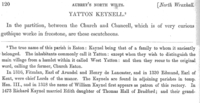
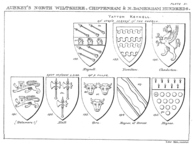
In the partition, between the Church and Chancell, which is of very curious
gothique worke in freestone, are these escutcheons.
1. KEYNELL (No. 188)
2. YEVELTON, I guess (No. 189)
3. CHADERTON (No. 190)
4. Two lions, or griffins, defaced. (The former; for DELAMERE, No. 191. Ed.)
In the East windowe of the South Aisle, is the coate of HALL. (No. 192)
On a pillar, on a stone scutcheon is KEYNELL (as before). On the other side, in a stone escutcheon, GORE (No. 193), and two other scutcheons scraped out.
I have heard my grandfather say that when he went to school in this Church, in the S. windowe of the Chancell, were several escutcheons, which a herald,
that passed by, tooke note of, which window is now dammed up with stones, and now no memorie left of them. [2]
The pulpit is of stone, the most curious carving in our country. [3]
On the first Bell this Inscription: ETERNIS ANNIS RESONET TAMPANA JOHANNIS.
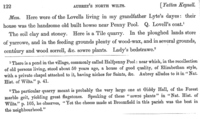
Mem. Here were the Lovells living in my grandfather Lyte's dayes: their house was the handsome old built howse near Penny Pool.
Q. Lovell's coat. [4]
The soil clay and stoney. Here is a Tile quarry. In the ploughed lands store of yarrowe, and in the feeding grounds plenty of wood-wax,
and in several grounds, centaury and wood sorrell, &c. sowre plants. Lady's bedstrawe. [5]
John Aubrey died before was able to research and publish the notes he made during his journey around Wiltshire. Some two hundred years later John Jackson undertook this task, and below
is his corrections and updated information.
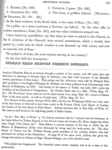
[1] The true name of this parish is Eaton: Kaynel being that of a family to whom it anciently belonged. The inhabitants
commonly called it Yatton: except when they wish to distinguish the main village from a hamlet within it called West Yatton: and
then they recur to the original word, calling the former, Church Eaton.
In 1316 Fitzalan, Earl of Arundel and Henry de Lancaster, and in 1330 Edmund, Earl of Kent, were chief Lords of the manor. The Kaynels
are found in adjoining parishes in temp. Hen. III., and in 1318 the name of William Keynel first appears as patron of this rectory. In 1473
(*see later note) Richard Kaynel married Edith daughter of Thomas Hall of Bradford; and their grand-daughter Elizabeth Kaynel an heiress
brought a moiety of the manor, and 590 acres here and elsewhere, in marriage to Thomas Gore of Alderton, who died 1532 (ancestor of the
Heraldic country gentleman of that name.) This moiety and the Advowson were sold by Richard Gore their grandson to the Snells of
Kington St. Michael, (in whose pedigree is an intermarriage with Kaynal of Biddeston,) in 1557. One moiety of the manor of Yatton was
held, 1587, under the Lordship of the Hundred of Chippenham. Sir Charles Snell sold it c. 1623 (Wilts. Mag. IV. 45). The Yeoviltons
whose arms are on the stone screen were, temp. Edw. III. owners of Easton Piers in the next parish: as well of lands here. (Wilts. Mag. IV. 75.)
Two Rectors of this parish, George Child, 1661, and his son Williamson Child were very near of kin (the former is believed to have been uncle)
to Sir Francis Child, Lord Mayor of London, the founder of the first Bank, in Fleet Street. Aubrey mentions this in Nat. Hist. of Wilts.
70. The name is still found in the adjoining parish of Castle Combe.
[2] In his "Nat. Hist. of Wilts." p. 79, Aubrey mentions that he "entered into his Grammar at the Latin School at Yatton Keynel, in the
Church were the Curate, Mr. Hart, taught the eldest boys, Virgil, Ovid, Cicero, &c." Then follows a curious account of the way in which
the old Missals of Malmesbury Abbey were destroyed by being used for book-covers, &c. The then Rector of Yatton was Mr. William Stump,
great grandson of the wealthy clothier who had purchased the Abbey at the Dissolution. At page 81 of the same work, Aubrey also gives the
strange adventures in Guiana of Cept. Thomas Stumpe, one of the Rector's sons.
[3] This pulpit has disappeared. The beautiful stone screen remains, and is in a state of fair preservation.
[4] There is a pond in the village, commonly called Halfpenny Pool: near which, in the recollection of old persons living, stood about
50 years ago, a house of good quality, of Elizabethan style, with a private chapel attached to it, having niches for Saints, &c. Aubrey alludes
to it in "Nat. Hist. of Wilts." p. 41.
[5] The particular quarry meant is probably the very large one at Giddy Hall, of the Forest marble grit, yielding great flagstones.
Speaking of these "sowre plants" in "Nat. Hist. of Wilts." p. 105, he observes, "Yet the cheese made at Broomfield in this parish was the best
in the neighbourhood."
* In the copy of the book I have, someone has written "must have been earlier than that as she is mentioned in Thomas Hall's will of 1457."
These are not 'Thumbnails'. Please read the copyright conditions.
The individual crests are less than three centimetres wide, so the quality may appear distorted, depending on the size of the screen you are viewing them on.