
HOME  |  DONATE  |  FOOT  |
Want to copy an image?   Please read the   copyright © conditions   first.

John Aubrey's visit to Calne


Search surnames at  this  location or  all  locations

Calne page   or   Main Index

Text     by John Aubrey (1660s)
Notes   by John Jackson (1860s)
Plates   (sketches) by Edw. Kite

Page 31
These are not 'Thumbnails'.   Please read the   copyright   conditions.

Text

 | Top  | Notes  | Plates  |  Foot  |

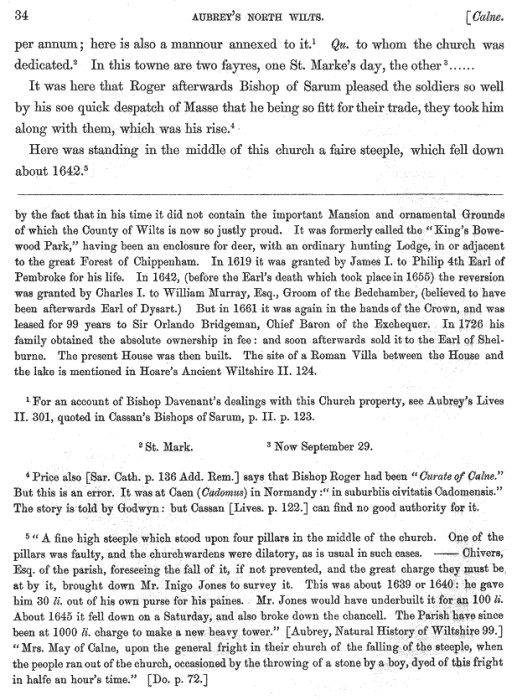
CALNE [*1]

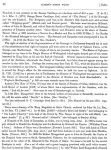
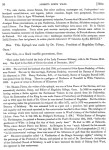
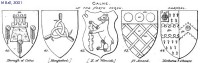
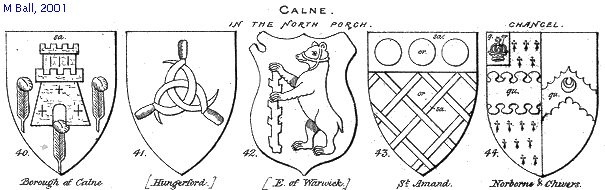
The charter was granted to this towne by King Stephen wherein is a privilege for their buying and selling in any part of England without paying tonnage and poundage.   Arms of the Borough (Pl. iii No. 40)

Here was anciently a castle, which stood where Mris Norborne's house now does. [*2]

A Councell was held in this town, (perhaps it was in the Castle) where was a great fall, and St. Dunstan, being then President or Prolocutor, was saved by ... [*3]

King Henry the First, who was a very great benefactor to the Cathedrall Church of Sarum, did by his Deed, bearing date ... (which is amongst their evidences at Sarum) give to that church the tythes of all his forests and chases in Wilts, Dorset and Berks, Godalming in Surrey cum multis aliis, and the tythe of Calne, a great Tything, 10 miles long, with the appurtenances, (viz. the tythings of Cherhill, Berwick, Calston, Quemmerford, Stock, Stockley, both Studeleys, Eastmeadstreet, Whitley and Whetham). [*4]   The parsonage of Calne is the corps of the Treasurer of the Cathedrall Church of Sarum; the demesne is worth between £400 and £500 per annum; here is also a mannour annexed to it. [*5]   Qu. to whom the church was dedicated. [*6]   In this towne are two fayres, one St. Marke's day, the other ... [*7]

It was here that Roger afterwards Bishop of Sarum pleased the soldiers so well by his soe quick despatch of Masse that he being so fitt for their trade, they took him along with them, which was his rise. [*8]

Here was standing in the middle of this church a faire steeple, which fell down about 1642. [*9]

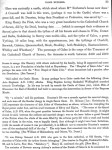
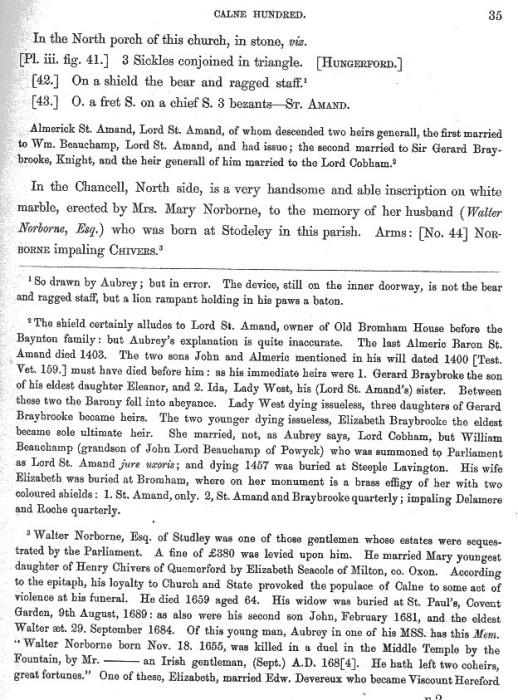
In the North porch of this church, in stone, viz.

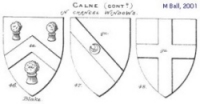
(Pl. iii. fig.41.)   3 Sickles conjoined in triangle. (Hungerford) (42.)   On a shield the bear and ragged staff. [*10] (43.)   O. a fred S. on a chief S. 3 bezants - St. AMAND.

Almerick St. Amand, Lord St. Amand, of whom descended two heirs generall, the first married to Wm. Beauchamp, Lord St. Amand, and had issue; the second married to Sir Gerard Braybrooke, Knight, and the heir generall of him married to the Lord Cobham. [*11]

In the Chancell, North side, is a very handsome and able inscription on white marble, erected by Mrs. Mary Norborne, to the memory of her husband (Walter Norborne, Esq.) who was born at Stodeley in this parish.   Arms: (No. 44) NORBORNE impaling CHIVERS. [*12]

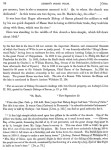
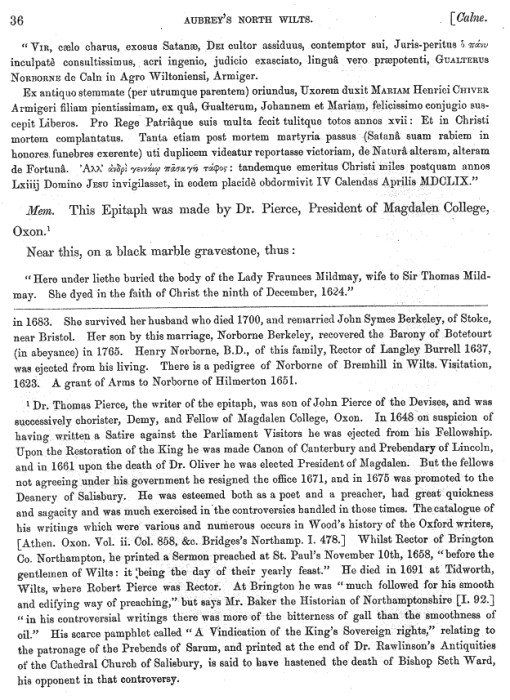
"VIR, caelo charus, exosus Saatanae, DEI cultor assiduus, contemptor sui, Juris-peritus ... inculpate consultissimus, acri ingenio, judicio exasciato, lingua vero praepotenti, GUALTERUS NORBORNE de Caln in Agro Wiltoniensi, Armiger.

Ex antiquo stemmate (per utrumque parentem) oriundus, Uxorem duxit MARIAM Henrici CHIVER Armigeri filiam pientissimam, ex qua, Gualterum, Johannem et Mariam, felicissimo conjugio suscepit Liberos.   Pro Rege Patriaque suis multa fecit tulitque totos annos xvii:   Et in Christi mortem complantatus. Tanta etiam post mortem martyria passus (Satana suam rabiem in honores funebres exerente) uti duplicem videatur reportasse victoriam, de Natura alteram, alteram de Fortuna. ..............: tandemque emertus Christi miles postquam annos Lxiiij Domino JESU invigilasset, in eodem placide obdormivit IV Calendas Aprilis MDCLIX."

Mem.   This Epitaph was made by Dr. Pierce, President of Magdalen College, Oxon. [*13]

Near this, on a black marble gravestone, thus:

"Here under liethe buried the body of the Lady Fraunces Mildmay, wife to Sir Thomas Mildmay.   She dyed in the faith of Christ the ninth of December, 1624."

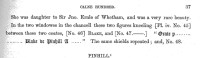
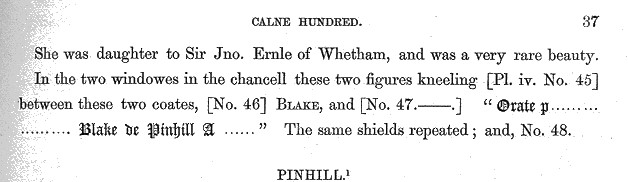
She was daughter to Sir Jno. Ernle of Whetham, and was a very rare beauty.

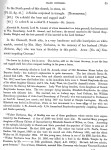
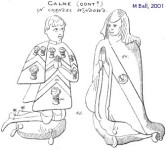
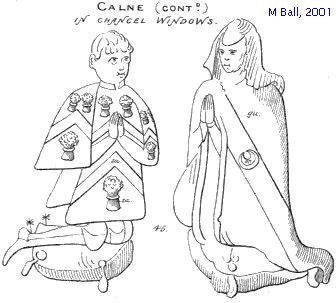
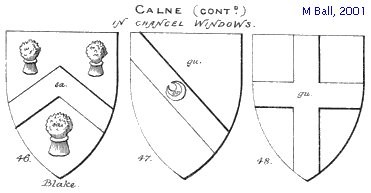
In the two windowes in the chancell these two figures kneeling (Pl. iv. No. 45) between these two coates, (No. 46) BLAKE, and (No. 47) ...   "Orate p... Blake de Pinhill A ... "   The same shields repeated; and, No. 48.


Notes

 | Top  | Text  | Plates  |  Foot  |


John Aubrey died before was able to research and publish the notes he made during his journey around Wiltshire.   Some two hundred years later John Jackson undertook this task, and below is his corrections and updated information.

[1]   Whitaker [Hist of Manchester I. 187] derives the name of Calne (sometimes anciently spelled Colne), as well as that of the Colnes in Gloucestershire, from the Celtic, Col-aun, signifying a "station by the narrow water."   The neighbourhood of the town is by no means deficient in springs. A "Chany fountain" is named in a character of Bradenstoke Abbey.

The Church of Sarum had a large estate here of 11 Hides so early as Edward the Confessor.   [Doomesday.]   The Treasurer of Sarum had two thirds of the Borough in Edw. I.   The Manor of Calne (Cauna) was Royal Demesne temp. Wm. I. but ceased to be so in Hen. III. when, with the Hundred, it was granted to the Barons Cantilupe at a fee-farm rent of £15 a year.   (T. de N.)   In 1. Edw. I. (1272) George Baron Cantilupe died, seised of "Bur Buries," 1/3 of the Borough and the out-hundred.   The Burgesses paid him at St. Martin's 22d, church scot:   and services called "Chipping-gavel" (Market-rent and Brewin-gavel.   His heirs were his sister Milicent, (widow of John de Montalt, and wife of Eudo de Zouche of Harringworth,) and John de Hastings grandson of Johanna another sister.   Calne Manor and Hundred were in the share of Zouche.   Tanner (Mon. p. 596) mentions a Charter for a Market and Fair in 1303, 32 Edw. I.   In Charles I. the Hundred belonged to the Crown.   The Steward and Burgesses were incorporated 4 Jas. II. (1688.)   In 1711 the Manor was Geo. Duckett's.

The right of election of the Representatives of the Borough in Parliament formerly lay in such of the inhabitants as had right of common and were sworn at the Court of Ogbourn Parva, or St. George, near Marlborough.   The origin of this is not precisely known.   The Manor of Ogbourn belonged at one time to the King's Honour of Wallingford which again formed part of the estate bestowed by King John on his son the Earl of Cornwall.   Several places in this county formed part of the Earldom, afterwards the Duchy of Cornwall, but Calne does not appear among the number in the older lists.   Perhaps the custom may date from H. VII., when the Zouche's Estate here was forfeited to the Crown.   The burgesses holding under the Crown may have been ordered to attend the King's officer for his convenience, when he held his court at Ogbourn.   In 32. H. VIII. (1540) by a private Act of Parliament the Honour of Wallingford was separated from the Duchy of Cornwall and united in the Honour of Ewelme now Lord Macclesfield's.   In "Waylen's Marlborough," p. 549 are some remarks upon this custom.

Aubrey (Nat. Hist. of Wilts, 79) says that of the famly of Forman of Calne, clothiers, was the Lord Mayor of London (1538) at whose Show was a representation of the Creation, with the motto, "And all for man.   Stow says that he was of Gainsborough, co. Lincoln.

In 1544 Edw. Hungerford (first of the branch settled at Cadenham in Bremhill) mentions in his will his estate called "Berrils" in Calne.   (See "Studley".)

The late celebrated S. T. Coleridge lived here in 1814.   (See Memoir by his son 1851, App. cxcviii.)

There was a chantry of St. Mary Magdalen in Calne Church, endowed by John St. Lo, Esq., in 23 Hen. VI (1445-6).   In 43 Elizabeth (1600) "Abbard's Mead and Seal's" late belonging to "Our Lady's Chantry" were held by the Crown by Wm. Seager in right of his wife Edith, "per legem Angliae." (I.p.M.)   Ground called "Abbard's" also belonged to Stanley Abbey.

A Hospital of St. John of Jerusalem, at Calne, was in being temp. John.   In 1202 a house was quit claimed to Ernald the Presbyter and the Brethren by Richard the Tanner.   (Wiltshire Fines 4 John.)   Galiena of Calne was a Benefactor (Bowles's Lacock 328.)   They held lands at Ufcote under Lacock Nunnery (Do. App. xxxv.) and had three bushels of corn per week from Hudden, Berks.   (Tanner, 608.)   In 1336 Sir Robert Hungerford gave to John de Pewelle the Custos of the Hospital forty acres at Stock, Quemerford, Calstone, &c. for maintenance of a daily mass for his soul at the Altar of St. Edmund in the Church of Calne:   the mass to be said by the second Presbyter in rank.   Also a set of robes, and a green hanging powdered with small white crosses.   The deed is dated at Calne.   (Hungerford Chartulary.)   In 1442 Walter Lord Hungerford obtained license to merge this Chantry with others endowed by his family, being ill supported and some vacant, in a new Foundation of similar kind at Heytesbury.   The "Hospital of Saint John" was perhaps the same with the "Free Chapel of Saint John" whose incumbent had a pension after the Dissolution.   (See Tanner.)

[2]   Still called the Castle House.   It may perhaps be to Calne castle that the following (from Acta Stephani. A.D. 1139,) alludes.   King Stephen having blockaded Wallingford marched towards Trowbridge.   In his way he took by assault the Castle of Cerne (sic), which Milo of Gloucester the Earl of Hertford had built to encourage the insurrection in favour of the Empress Maude.

[3]   By "a miracle," said his partisans.   Dunstan's life was a crusade against the married clergy, and such were all the Secular clergy in Anglo Saxon times.   Dr. Milman (Lat: Christianity iii. 115) represents the character of this Abbot of Glastonbury as odious, witness his trampling the Royal power under foot, and his cruel treatment of Edwy and Elgiva.   "The scene at the Synod of Calne, A.D. 978, when the great question between the Secular and Monastic clergy, (it might almost be said, between the celibate and married clergy) was on the issue before a great Council of the Nation when the whole of the seats filled by the adverse party fell with a crash and buried many of them in the ruins, was so happily times, that although it might have been fortuitous, (with the monks of course it was providential), it is difficult not to remember Dunstan's mastery over all the mechanical skill of the day."   The only beam that remained was the one over which he was standing.   (See William of Malmesbury, and Osbern. Vit. Dunst.)

[4]   It was Bishop Osmond A.D. 1091 who gave to the first cathedral, at Old Sarum, "the churches of Calne with the tythes thereto belonging."   (See charter in English, Dodsworth's Salis. 98, and in Latin, New Mon. "Salisbury.")   Henry II. confirmed the gift.   (New Mon.)

The omission of BOWOOD among Aubrey's notices of the Parish of Calne is to be accounted for by the fact that in his time it did not contain the important Mansion and ornamental Grounds of which the County of Wilts is now so justly proud.   It was formerly called the "King's Bowewood Park," having been an enclosure for deer, with an ordinary hunting Lodge, in or adjacent to the great Forest of Chippenham.   In 1619 it was granted by James I. to Philip 4th Earl of Pembroke for his life.   In 1642 (before the Earl's death which took place in 1655) the reversion was granted by Charles I. to William Murray, Esq., Groom of the Bedchamber, (believed to have been afterwards Earl of Dysart.)   But in 1661 it was again in the hands of the Crown, and was leased for 99 years to Sir Orlando Bridgeman, Chief Baron of the Exchequer.   In 1726 his family obtained the absolute ownership in fee:   and soon afterwards sold it to the Earl of Shelburne.   The present House was then built.   The site of Roman Villa between the House and the late is mentioned in Hoar's Ancient Wiltshire II. 124.

[5]   For an account of Bishop Davenant's dealings with this Church property, see Aubrey's Lives II. 301, quoted in Cassan's Bishops of Sarum, p.II. p.123.

[6]   St. Mark.

[7]   Now September 29.

[8]   Price also (Sar. Cth. p. 136 Add. Rem.) says that Bishop Roger had been "Curate of Calne."   But this is an error.   It was at Caen (Cadomus) in Normandy:   "in suburbiis civitatis Cadomensis."   The story is told by Godwyn:   but Cassan (Lives p.122.) can find no good authority for it.

[9]   "A fine high steeple which stood upon four pillars in the middle of the church.   One of the pillars was faulty, and the churchwardens were dilatory, as is usual in such cases.   ... Chivers, Esq. of the parish, foreseeing the fall of it, if not prevented, and the great charge they must be at by it, brought down Mr. Inigo Jones to survey it.   This was about 1639 or 1640:   he gave him 30 li. out of his own purse for his paines.   Mr Jones would have underbuilt it for an 100 li.   About 1645 it fell down on a Saturday, and also broke down the chancell.   The Parish have since been at 1000 li charge to make a new heavy tower."   (Aubrey, Natural History of Wiltshire 99.)   "Mrs May of Calne, upon the general fright in their church of the falling of the steeple, when the people ran out of the church, occasioned by the throwing of a stone by a boy, dyed of this fright in halfe an hour's time."   (Do. p.72.)

[10]   So drawn by Aubrey; but in error.   The device, still on the inner doorway, is not the bear and ragged staff, but a lion rampant holding in his paws a baton.

[11]   The shield certainly alludes to Lord St. Amand, owner of Old Bromham House before the Baynton family:   but Aubrey's explanation is quite innaccurate.   The last Almeric Baron St. Amand died 1403.   The two sons John and Almeric mentioned in his will dated 1400 (Test. Vet. 159) must have died before him:   as his immediate heirs were 1. Gerard Braybroke the son of his eldest daughter Eleanor, and 2. Ida, Lady West, his (Lord St. Amand's) sister.   Between these two the Barony fell into abeyance. Lady West dying issueless, three daughters of Gerard Braybrook became heirs. The two younger dying issueless, Elizabeth Braybrooke the eldest became sole ultimate heir. She married, not, as Aubrey says, Lord Cobham, but William Beauchamp (grandson of John Lord Beauchamp of Powyck) who was summoned to Parliament as Lord St. Amand jure uxoris; and dying 1457 was buried at Steeple Lavington.   His wife Elizabeth was buried at Bromham, where on her monument is a brass effigy of her with two coloured shields:   1. St. Amand, only.   2. St. Amand and Braybrooke quarterly; impaling Delamere and Roche quarterly.

[12]   Walter Norborne, Esq. of Studley was one of those gentlemen whose estates were sequestrated by the Parliament.   A fine of £380 was levied upon him.   He married Mary youngest daugher of Henry Chivers of Quemerford by Elizabeth Seacole of Milton, co. Oxon.   According to the epitaph, his loyalty to Church and State provoked the populace of Calne to some act of violence at his funeral.   He died 1659 aged 64.   His widow was buried at St. Paul's, Covent Garden, 9th August, 1689:   as also were his second son John, February 1681, and the eldest Walter aet. 29. September 1684.   Of this young man, Aubrey in one of his MSS. had this Mem.   "Walter Norborne born Nov. 18. 1655, was killed in a duel in the Middle Temple by the Fountain, by Mr. .... an Irish gentleman, (Sept.) A.D. 1684.   He hath left two coheirs, great fortunes."   One of these, Elizabeth, married Edw. Devereux who became Viscount Hereford in 1683.   She survived her husband who died 1700, and remarried John Symes Berkeley, of Stoke, near Bristol.   Her son by this marriage, Norborne Berkeley, recovered the Barony of Botetourt (in abeyance) in 1765.   Henry Norborne, B.D., of this family, Rector of Langley Burrell 1637, was ejected from his living.   There is a pedigree of Norborne of Bremhill in Wilts. Visitation, 1623.   A grant of Arms to Norborne of Hilmerton 1651.

[13]   Dr Thomas Pierce, the writer of the epitaph, was son of John Pierce of the Devises, and was successively chorister, Demy, and Fellow of Magdalen College, Oxon.   In 1648 on suspicion of having written a Satire against the Parliament Visitors he was ejected from his Fellowship.   Upon the Restoration of the King he was made Canon of Canterbury and Prebendary of Lincoln, and in 1661 upon the death of Dr. Oliver he was elected President of Magdalen.   But the fellows not agreeing under his government he resigned the office 1671, and in 1675 was promoted to the Deanery of Salisbury.   He was esteemed both as a poet and a preacher, had great quickness and sagacity and was much exercised in the controversies handled in those times.   The catalogue of his writings which were various and numerous occurs in Wood's history of the Oxford writers, (Athen. Oxon. Vol ii. Col. 858, &c. Bridge's Northamp. I. 478.)   Whilst Rector of Brington Co. Northampton, he printed a Sermon preached at St. Paul's November 10th, 1658, "before the gentlemen of Wilts:   it being the day of their yearly feast."   He died in 1691 at Tidworth, Wilts, where Robert Pierce was Rector.   At Brington he was "much followed for his smooth and edifying way of preaching," but says Mr. Baker the Historian of Northamptonshire (I. 92) "in his controversial writings there was more of the bitterness of gall than the smoothness of oil."   His scarce pamphlet called "A Vindication of the King's Sovereign rights," relating to the patronage of the Prebends of Sarum, and printed at the end of Dr. Rawlinson's Antiquities of the Cathedral Church of Salisbury, is said to have hastened the death of Bishop Seth Ward, his opponent in that controversey.


Plates (sketches)

 | Top  | Text  | Notes  |  Foot  |


The individual crests are less than three centimetres wide, so the quality may appear distorted, depending on the size of the screen you are viewing them on.


These images are from the book Wiltshire Collections.   Each page has some text and some notes - in order to read it more easily, the pages have been cut and pasted to keep the text separate from the notes.   However, this does mean they appear rather untidy in places.   The shaded areas at the side of some pages are where the pages were not flat against the scanner - pressing the book flat may have damaged the book.

The book   Wiltshire Collections   by John Aubrey and John Jackson was published by the Wiltshire Archaeological and Natural History Society in 1862.   The book is no longer covered by copyright regulations and the Society is happy for information from the book to be copied, although ask that an acknowledgement to the Society is placed with the reproduction.   The copyright of these images from the book is owned by Mandy Ball so they are covered by copyright regulations - see our   copyright conditions   of use.)   The Society can be contacted at:   The Wiltshire Archaeological and Natural History Society, Long Street, Devizes, Wiltshire.   Telephone:   +44 (0)1380 727369.

Top   or   Calne page   or   Main Index

Search surnames at  this  location or  all  locations

HOME     Background     Construction     Contact Us     Donate     FAQs     Links     Main Index     Us     War Memorials     Wiltshire Collections     TOP

This page was last updated on 10th July 2007 .